Morning Coffee: The macro hedge fund manager whose resignation now would be catastrophic. Ken Griffin's favourite book
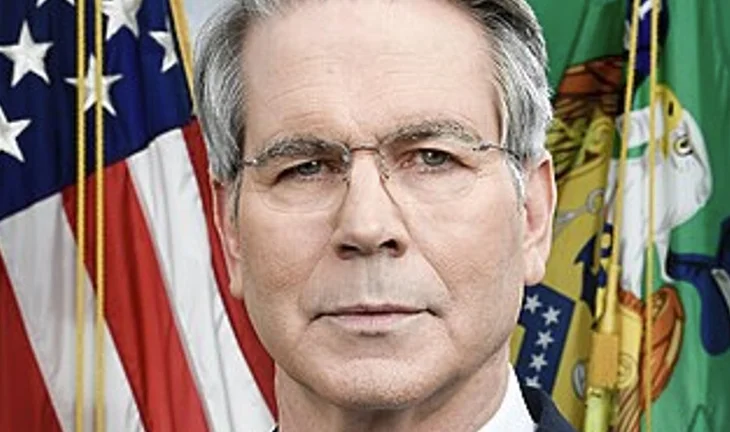
If there's a man with a plan who understands markets in the Trump II era, it's treasury secretary Scott Bessent. A macro portfolio manager and former chief investment officer of Soros Investment Management, Bessent is credited with bringing some intentionality to the chaos that's wiped $4.5 trillion from markets since Liberation day. So far, we've simply seen short term reactions by "organic animals," Bessent claimed yesterday. “We get these short-term market reactions from time to time...The market consistently underestimates Donald Trump.”
Click here to follow our WhatsApp channel, and get news updates straight to your phone 📱.
This is good, because a previous Bloomberg article on Friday suggested that Bessent wasn't happy with the way tariffs were turning out and that he was trying to distance himself from their outcome. Citing a person 'familiar with the matter,' Bloomberg suggested Bessent had been sidelined during the tariffs' formulation. Instead, Bloomberg said tariffs had been shaped by a 'small group' within Trump's inner circle, where ex-Cantor Fitzgerald CEO Howard Lutnick and maverick economist Peter Navarro reign supreme. Hedge fund managers phoning Bessent about the market chaos last week reportedly found that he was powerless to help them.
This was followed by another article, in the left-leaning New Republic, also on Friday, suggesting Bessent might even resign. “My sources say that Scott Bessent is kind of the odd man out here and, in the inner circle that Trump has, he’s not even close to Scott Bessent or listening to him,” wrote former Bloomberg editor Stephanie Ruhle, without explaining who her sources were. "Some have said to me, he’s looking for an exit door to try to get himself to the Fed, because in the last few days he’s really hurting his own credibility and history in the markets....”
If Bessent were indeed to resign, the market reaction could be even more extreme than we've seen so far. For the moment, he's credited with bringing some intentionality to the chaos. At Soros, he was said to have imbued the notion of "reflexivity," that markets exist in a self-reinforcing feedback loop in which markets influence fundamentals.
On this basis, Bessent's hope seems to have been that a virtuous circle would begin. - Treasury yields would fall as economic growth increased, as domestic oil and gas production rose, and as the government cut the budget deficit and inflation. Instead, Treasury yields have indeed been falling - but only because investors have been rushing to buy Treasuries as a safe asset amidst the turbulence.
Separately, if you want to ingratiate yourself with Ken Griffin at Citadel, there's an ancient and out-of-print book you should probably read while it's still available. Titled, 'Hardball: Are you playing to play or playing to win," it's reportedly Griffin's favourite and defines his approach.
David Senra at the Colossus podcast, says he has this book and that it illumines Griffin's approach. Hardball companies have total commitment, says Senra. They don't want to win 2 to 1; they would prefer a 9 to 2 rout. "You don't play to win; you play to win by a landslide," says Senra. This is how Ken thinks. Interesting to see how that plays out in current markets.
Meanwhile...
Several big banks issued their largest margin calls to clients since the start of the pandemic. We are proactively reaching out to clients to understand [risk] across their overall books,” said a prime brokerage executive at a second large US bank. (Financial Times)
Bessent has been urging countries not to retaliate on tariffs. “Sit back, take it in, and let’s see how it goes”. (FT)
Guneet Dhingra, head of macro strategy at BNP Paribas, says watch the Bessent put. Bessent can manipulate treasuries by cutting issuance of 10 year bonds and issuing short-dated treasury bills instead. “It makes it difficult for the yield curve to steepen much. It makes it difficult for the yield curve to flatten much.” (Risk)
Scott Bessent on his early life: "My dad made a lot of bad financial choices. So... When I was born, first six, seven, eight years, we were affluent. He lost everything. And so, I've seen what that's like. I've seen both sides. I was fortunate enough to be able to make it back..." (YouTube)
Equity long short hedge funds fell 1.7% on Thursday and were then down 1.6% for the year. (Reuters)
On Thursday, hedge funds sold equities on a net basis at their fastest rate since 2010. (X)
Private equity firms are a leveraged bet on equities. Shares of Blackstone, Apollo Global Management and KKR were there down sharply early Friday, after falling 10%, 13% and 15%, respectively, on Thursday. (WSJ)
Private equity firms did a lot of analysis work ahead of the tariffs, it was all wasted when the formula 'came nowhere near people's expectations'. (FT)
IPOs are being postponed because of the tariffs. $15bn fintech Klarna, ticket company "Stubhub" and $50bn medtech company Medline, have called their plans off. (Financial Times)
Steve McLaughlin, banker and founder of investment firm Financial Technology Partners: “There’s no way on God’s green earth I would recommend any fintech company go public right now, particularly the ones on deck.” (WSJ)
New issuance of junk debt has ground to a halt in the US. The past six trading sessions saw just one new high-yield bond and no leveraged loan launches. (Bloomberg)
Hedge fund manager Rob Citrone is feeling the heat. “This environment is one of those times when my investment roadmap feels less like a drive down I-95 and more like navigating NYC rush hour with Waze constantly rerouting every 30 seconds." (Bloomberg)
The U.S. in 2024 imported around $440 billion of goods from China. China in 2023 was the source of a fifth of iron and steel products imported into the U.S., more than a quarter of its imported electronics, a third of its imported footwear and three-quarters of its imported toys. (WSJ)
Hey, retail traders were still buying the dip. (Financial Times)
Trump is starting a "gold card" US residency program. “We’re going to be putting a price on that card of about $5 million, and that’s going to give you green card privileges.” (Bloomberg)
Matt Eilers from UBS joined Bank of Novia Scotia as global co-head of corporate and investment-banking. (Bloomberg)
BNP Paribas is bringing in Mark Lynagh from its New York business to succeed Matthew Ponsonby as its head of UK banking. (Financial News)
Students are boycotting jobs at law firm Paul Weiss, Skadden Arps because of its affinity to Trump. (WSJ)
You can buy a "Strava mule", allegedly paid to boost other people’s scores by running or cycling wearing their smartwatch. (Financial Times)
We need to bring back economic policy made by veterans of classy investment banks like Goldman Sachs, no more of this c-tier Cantor Fitzgerald slop.
— Matthew Yglesias (@mattyglesias) April 4, 2025
At Goldman, I would've been expected to commit seppuku for these errors https://t.co/5D2zbm0QyP pic.twitter.com/wiEKAw9odB
— Ana Mostarac (@anammostarac) April 3, 2025
Have a confidential story, tip, or comment you’d like to share? Contact: +44 7537 182250 (SMS, Whatsapp or voicemail). Telegram: @SarahButcher. Click here to fill in our anonymous form, or email editortips@efinancialcareers.com. Signal also available.
Bear with us if you leave a comment at the bottom of this article: all our comments are moderated by human beings. Sometimes these humans might be asleep, or away from their desks, so it may take a while for your comment to appear. Eventually it will – unless it’s offensive or libellous (in which case it won’t.)