And 2011 will be a poor year for...

The preamble to 2011 wasn't great. 2010 deteriorated from April and ended on an uncertain note. Is 2011 going to mark a continuation of the degradation of investment banks to the status of functional utilities?
Yes, according to Mike Mayo. In October 2010, Mayo pronounced that 2011 will start a decade which could bring the worst period of revenue growth for US banks for 80 years.
"Revenues aren't just weak for this quarter, or even for this upcoming year, but for the entire upcoming decade," he declared.
Naturally, some things will be worse than others. For true nastiness in 2011, we suggest you look at:
1) Returns on equity
Face it, investment banking margins are falling. In late December, the Financial Times quoted Bill Winters, the former co-head of JPMorgan's investment bank, as saying that, in future: "The best-run banks will be able to generate a ROE of maybe 13%, compared with 20-25% historically. There will be a middle tier on 9, 10, 11% and then the weakest ones below that."
Winters isn't the only one foreseeing a negative evolution in ROE. Glenn Schorr at Nomura points out that Goldman's ROE is on a definite downward trend.
The causes of the decline are legion, but relate mostly to regulation and increased capital requirements. JPMorgan analyst Kian Abouhossein predicts an aveage 8.2% decrease in ROE over the next few years based on the regulatory changes detailed below.

Source: JPMorgan.
2) Compensation
With returns on equity diminishing, banks would like to slice into compensation to get them back up. Glenn Schorr, analyst at Nomura outlines the new reality: "...simplistically, unless investment banks are successful in significantly increasing margins or business mix, or pushing compensation costs lower (unlikely in 2011), pro forma ROEs appear to be not
much more than the cost of equity."
Schorr thinks banks will struggle to reduce compensation as the "competition for talent is intense." Ultimately, however, banks will have to make a call: reduce compensation, increase margins, or lose investors.
3) Headcount
2011 is also unlikely to be a great year for adding headcount. After Goldman, Deutsche, Credit Suisse, UBS and JPMorgan added a combined nearly 10,000 people in 2010, 2011 is predicted to be a year of taking stock.
"There's an atmosphere of realism. The revenues aren't there," suggests one fixed income headhunter. Although both big banks and smaller banks have spaces to fill, they are likely to do so warily, with an eye to the evolving sovereign debt situation.
Some banks are also expected to trim staff. We suggest that the most likely trimmers are UBS, BarCap and Credit Suisse.
The most apocalyptic headcount prediction for 2011 is attributable to Meredith Whitney, who has had premonitions of an 80,000 person reduction in US securities industry headcount in the next 12 months.
4) Non-EU migrants
In April 2011, the UK government will introduce its new immigration cap. There have been efforts to mitigate the effects for investment banks by excluding anyone earning less than 150k or transferred internally, but the new limit won't go unnoticed.
From April 2011, the Tier 1 General Visa previously favoured by highly skilled non-EU migrants to the UK is being abolished. In its place, there will be a 'Tier 2' visa for everyone. Although more Tier 2 visas will be handed out in 2011 than 2010, the loss of the Tier 1 Visa won't be totally nullified, with a shortfall of 7,400 visas expected in total.
The head of recruitment at one US investment bank in the City has described the changes as, "a nightmare."
5) Fixed income, currencies and commodities
In 2010, fixed income currencies and commodities (FICC) were the big driver of first half hiring, This is unlikely to be repeated in 2011.
As spreads tighten, analysts at JPMorgan are predicting a compound annual reduction of 4% in FICC revenues between 2010 and 2012. After strong FICC growth between 2000 and 2006, the crash of 2008, and a soaring recovery in 2009, negative revenue growth could come as a shock.

Source JPMorgan.
Not everyone shares the FICC revenue pessismism however. Lloyd Blankfein recently told Nomura analyst Glenn Schorr that he's optimistic about FICC in 2011 on the grounds that volatility will drive commodities revenues and that "something will eventually have to give on interest rates and inflation," creating impetus for higher trading volumes.
Goldman may, however, prove the exception. The bank is well placed to benefit from FICC-related flow because of its size. While big FICC players may benefit in 2011, the market overall is likely to be tighter. Hiring can be expected to fall as a result.
Leading us to...
6) UBS
UBS is counting on FICC revenues being strong. It spent 2010 rebuilding its FICC teams (it hired 420 people) and aims to make more than CHF8bn in revenues from its reinvigorated FICC business annually in future, up from an anticipated CHF6.3bn in 2009.
In a moribund market, this could prove a challenge. By the end of 2010, big questions were being raised about UBS's strategy, with analysts pointing out that the clean cost income ratio in the investment bank was 98% in the third quarter.
"UBS is now one year into a three-to-five-year turnaround plan and the targets don't look any more achievable than they did 12 months ago," suggested BAML analyst Derek De Vries in November.
Will 2011 be the year in which UBS's strategy comes unstuck? Maybe. Morgan Stanley analysts point out that it also faces a challenge from Swiss regulators who are imposing a penal 19% equity-plus-CoCo capital requirement to encourage both UBS and Credit Suisse to scale back risk. On the contrary, if UBS wants to meet its targets, analysts say it will have to ramp risk up. Something will have to give.
.
7) BarCap
If UBS is at risk of coming undone, so is BarCap.
BarCap's particular problem is increased regulatory capital requirements. In November, analysts at UBS claimed that if BarCap had been obliged to operate under Basel III since its inception, it would have made an economic loss every single year.
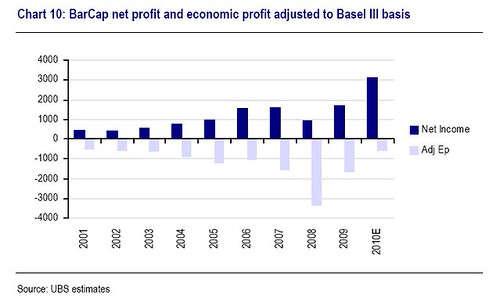
Nomura analysts agree that BarCap faces a big challenge. In 2010, they claim it's in danger of generating a return on equity of just 9%. To achieve a 15% ROE on regulatory capital, it would need to increase profit before tax by 2.5bn in 2011.
BarCap isn't oblivious to the challenge. In November, it began a review of its business with a view to assessing which areas use the most capital and therefore need to be cut back in 2011. FICC businesses like securitisation, credit derivatives, and correlation trading are thought to be most at risk of redundancies.
Long term, UBS analysts predict that BarCap will continue its reorientation away from FICC and towards equities and investment banking.

8) Pay in OTC derivatives sales and trading
2011 will see a continuation of the remoulding of OTC derivatives businesses. Regulators in Europe and the US are pushing for the same thing - the standarisation of OTC derivatives contracts and the requirement that they're traded on exchanges and cleared through central counterparties by the end of 2012.
Shifting OTC business onto exchanges and through central clearing is expected to be good news for big banks, which have already rushed into the OTC derivatives clearing business and should benefit from increased volumes, but smaller players are already complaining about being shut out.
Headcount in credit derivatives businesses has been slashed in recent years, with Michael Karp, CEO of US search firm Options Group estimating that businesses which once employed 20-30 people in credit derivatives sales, now employ between 5 and 10.
As OTC derivatives become more vanilla and shift onto exchanges, the OTC derivatives workforce will need to evolve again. Sales will become about flogging systems. There will also be implications for compensation. "As derivatives become more vanilla, people are going to be paid less," says Lee Thacker at search firm Silvermine Partners.
9) The FSA
2011 will be the beginning of the end for the FSA. Although the UK regulator isn't officially disbanded until 2012, in April 2011 it will start separating out its risk and supervision teams into the embryos of the two new regulators it will ultimately turn into.
During this period, the FSA has warned that it might not be able to regulate 'low impact' firms as vigorously as it would like.
10) London
At the end of 2010, London received a large vote in its favour in the form of JPMorgan's decision to stick around and move into Lehman's old building in Canary Wharf. Jamie Dimon said kind things such as, "This acquisition is a long-term investment and represents part of our continued commitment to London as one of the world's most important financial centres."
Such platitudes should not be reason for complacency, however. The UK ended 2010 with the most punitive financial services pay regime anywhere in the world. Meanwhile, the Liberal Democrats continue to make noises about increasing pay disclosure and imposing a new bonus tax. London's place as a financial centre is not unassailable. In 2011 it could easily be assailed again.