Middle East: the strangely immobile growth market

For a moment, let's subscribe to the theory that the Middle East's emerging market status means that most international investment banks view it as a strategically important growth region.
The assumption therefore, as is the case with places like Asia and Latin America, would be that hiring should take place in anticipation of the potentially lucrative fees on offer in the not-too-distant future.
But while many banks talk the talk in the Middle East, few have actually rolled out significant recruitment plans.
A case in point is Goldman Sachs. Lloyd Blankfein, the bank's CEO, yesterday made a presentation to the BoA Merrill Financial Services Conference. As the chart below shows, headcount in what it deems 'growth markets' has seen a compound annual growth rate of 33% since 2003.
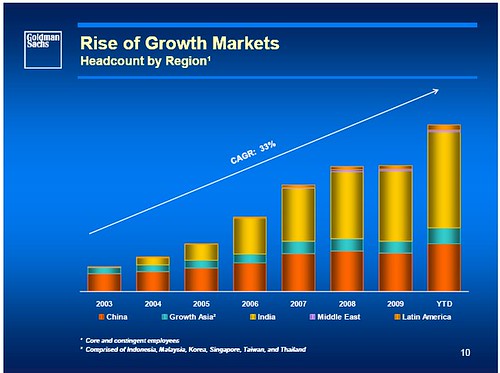
The Middle East has been there since 2008, but employee numbers look strangely static (and comparatively tiny), while other regions have clearly grown.
Staff numbers within international investment banks' Middle East operations have always been relatively diminutive. In 2008, when most firms were transferring key people to the region, this was expected to change, but as the crisis hit home in the Gulf most have curtailed these plans
Another bank to break out Middle East headcount is UBS, which employs just 139 people - a number that has largely remained static since the first half of 2009.
The reasons are fairly obvious - the fee pot remains too small to make a significant investment in people. To September this year, the total M&A fees paid to investment banks in the Middle East were $258.7m, according to Thomson Reuters.
Yes, this is marginally larger than the $221.1m at the same point in 2009, but let's not forget that total M&A activity in the Middle East last year was 50% down on 2008. It's easy to see why most investment banks are reluctant to jump into hiring big numbers.