IT in finance

Software, hard skills and a thick skin
The right technology is often the factor that
gives a financial services company the
edge over its competitors. It can also, in
the long run, help organisations save money.
Not surprisingly, therefore, firms in the financial
sector are among the biggest spenders on IT.
Investment banks, retail banks, fund managers,
brokers and insurance firms all spend billions
on technology. In 2010, financial services
firms are expected to spend US$357bn
on IT globally, according to research from
consultancy Celent.
The really big user of technology is the
trading floor, and everything related to it.
Whether it's a question of buying and selling
financial products electronically, processing
them through smart-order routing systems,
or communicating to ensure that trades
go through smoothly, multi-million dollar
technology projects are crucial to successful
operations.
After a period of shrinking IT budgets and
cancelled projects throughout 2008/09, financial
services firms have again focused on frontoffice
technology, prompting something of
a hiring spree in the sector.
Roles and career paths
Within financial services, IT roles tend to fall into
four camps - development, business analysis,
project management and technical support.
As a developer, you are at the coalface of
the IT department. Although some of the
job will involve developing new systems
in-house, banks often purchase software
from third-party vendors, their
developers tailoring the software to
suit the institution's particular needs
or integrating it into existing systems.
Developers aim for 'low latency' or
reducing the amount of time it takes
both to execute and process a trade.
The speed with which a trade is placed can be
crucial to its profitability, and may be as little as
microseconds.
Business analysts effectively act as the liaison
between the IT department and the company,
investigating how technology can be used to
improve the bank's competitive advantage.
Meanwhile, project managers will take the
reins of the new venture once it has been
given the go-ahead. Project management is a
strategic role involving planning, structuring and
eventual completion of the projects. You'll have
to manage a team of developers, liaise with
third-party vendors, and be answerable to the
business should plans go awry.
The people in technical support solve
problems when they arise on the trading floor.
This might sound simple, but glitches could
cost banks millions of dollars within minutes.
And traders aren't shy when it comes to
berating you for their IT gremlins, so a thick
skin is a must.
If you don't want to work for a bank, there's
the option of working for third-party vendors,
which specialise in providing software for a
particular sector. Try sending your CV to major
players such as Sungard or Oracle, or apply to
specialist financial services software vendors
such as Fidessa, Sophis, OpenLink or Charles
River. Vendors generally pay less but can
provide a good training ground to develop
your technical skills.
Pay and bonuses
IT pay doesn't reach the dizzy heights to
be found in investment banking, but it's not
pennies either. Generally, if you possess
knowledge of more complex financial products,
or have a comparatively rare skill set, the
greater your earning potential.
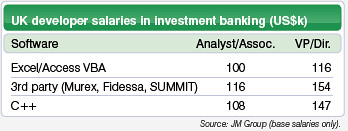
A salary survey by IT headhunter JM Group
revealed that a vice president business analyst
working on exotic derivatives can earn up to
US$140k in the UK; those working on simpler
'vanilla' products can get US$135k for the
same position. In Hong Kong, a programme
manager with over eight years' experience
can expect US$130k-255k, according to
recruiter Hudson's 2010 salary survey. A C++
developer with over six years under their belt
can earn US$90-155k.
Skills sought
The vast majority of successful applicants will
have a computer science degree, and those
who don't will come from a maths or physics
background. If you're seeking a development
role, experience with programming languages
like Java, C++, C# or Microsoft's .Net is
essential, but this is not to say you need to be
a whizz kid at entry level.
"Many will have a background in computer
studies but we often find that it helps to be able
to offer computer studies with something else,"
says Matthew Widders, global head of rates
support/EMEA FI support manager (technology)
at Citi. "Recent examples have included
artificial intelligence, finance, economics and
psychology. If you have not done computer
studies, that does not necessarily rule you out."
Technical skills will be nurtured, but the learning
curve is steep. "Entry-level positions have
become much more competitive over the past
two years," says Victor Lebreton, manager
of Paris-based electronic trading firm Quant
Hedge. "Don't be afraid to do internships
and learn as much as you can. But do not
exaggerate your skills, because you will
be found out."
Soft skills are valuable when it comes to
business analyst or project management roles.
Business analysts have to be able to explain
the pros and cons of a potential technology
investment without leaving non-IT people
swimming in a sea of jargon.
Project manager roles, meanwhile, are
essentially management positions for
developers, and you'll have to act as a central
coordinator for disparate groups with differing
interests. Even in highly technical roles, soft
skills are key, says Dipen Shah, an IT risk
analyst within fixed income at BNP Paribas:
"You could be dealing with queries from
traders looking for support on applications
or complaining that something is inaccurate,
liaising with developers, or co-ordinating with
managers from mid- and back-office teams."