EDITOR'S TAKE: A comprehensive guide to the attainment of happiness in the event of a paltry bonus

Two things have become apparent this week. The first is that, based on JPMorgan's Q3 results, compensation for 2010 will be down. The second is that, based on our own and other bonus expectations surveys, a majority of people are expecting their compensation to rise.
Given that this sounds like a recipe for disappointment, we would like to pre-empt any discontentment.
Why money doesn't create happiness
Much has been written about the fact that beyond a certain point, more money makes neither a society nor an individual more happy.
This week, Adair Turner, still chairman of the FSA, made an entire presentation at the London School of Economics on precisely this subject.
Once an economy reaches a certain level of economic and technical progress, further progress doesn't create more contentment, contended Turner, using the following graph to illustrate his point.
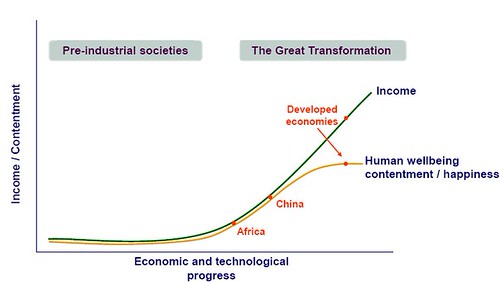
Source: LSE, Lionel Robbins Memorial Lectures, Adair Turner
The reasons for this are several. According to Turner they include:
1) Satiation and declining marginal benefits: No one needs two Porsches.
2) Relative income: It doesn't matter whether you've got two Porsches. What's crucially important is whether your colleague has three.
3) Congestion effects: As more people buy Porsches, they become more expensive and country roads fill up with bankers on weekend jaunts. The marginal utility of additional Porsches therefore diminishes.
4) Aspirational inflation: Every level of new income leads to new aspirations. And the fulfilment of the new aspiration doesn't lead to more happiness. Hence, Paul Krugman claims there are plenty of people in the US who earn $500k but barely have enough money to live on once they've paid school fees and mortgages.
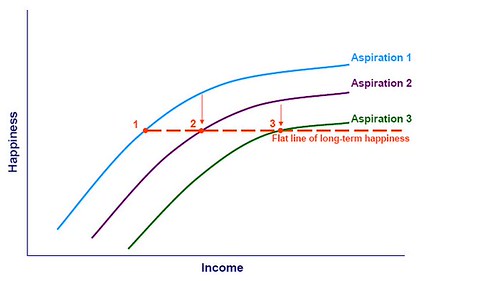
Source: LSE, Lionel Robbins Memorial Lectures, Adair Turner
How to feel great despite a bad bonus
The receipt of a small bonus should be no huge deal. Evidently, however, the receipt of a small bonus is an enormous deal - especially if it is smaller than a colleague's.
This is entirely natural. Turner points out that even though increases in income create only slight or negligible increases in welfare, any reduction in income is "strongly negative" for wellbeing.
How should you overcome this? The best course of action, preferably pursued at the earliest available opportunity to pre-empt a a joyless January, is as follows:
1) Focus hard on everyone else's bad bonus: Turner says most people are 'spiteful egalitarians.' They would rather that everyone becomes poorer than that they personally become richer if everyone else becomes even richer still. Spiteful egalitarians don't care as long as everyone's bonus falls as well as their own. For maximum utility, pay particular attention to people whose bonuses have fallen more.
2) Cultivate the belief that there is no link between money and goodness: Alain De Botton points out that in a meritocratic world, money and wealth have become associated with the notion that the rich are fundamentally better. However, if you believe - as most people in the UK now appear to - that a big bonus is, in fact, an indicator of moral repugnance, you will feel far more amiable when you don't get one.
3) Enjoy your job now: Turner says happiness is all about the "journey not the destination." Dr Srikumar Rao, a zen-business lecturer who has held classes at Columbia Business School and LBS, elucidates.
Rao defines happiness is a "profound sense of well-being that is with you all the time." In order to achieve this, he says you need to do...nothing. "Happiness is your innate nature. It is hardwired into your being. It is part of your DNA. It is always with you," Rao insists.
In order to tune in and turn on to this omnipresent happiness, Rao advises simply stepping back from the belief that you can only be happy if something happens.
You should still strive to achieve things, he says, "but you need to do it from the knowledge that your success or failure has no bearing on your essential wellbeing."
This being the case, life would be wonderful if you got a 500k bonus, but it will still be wonderful without it.
Repeat this three times a day between now and the New Year.