The real issue here? Banks didn't cut headcount nearly enough in 2008-2009

As 2010 front office hiring sputters to a horrible halt, a new refrain is starting up around the City: banks should've let a lot more people go in 2008 and 2009; the overstaffing issue was never properly dealt with then.
It was muttered by a senior banker at a drinks event midweek, and has now been committed to paper by Sanford Bernstein analyst Dirk Hoffman-Becking, who has statistics to prove it.
Hoffman-Becking refers to the graph below, which refers to the US securities industry but is a proxy for Europe too. He points out that after the financial crashes of 1987 and 2001, headcount fell 24% and 20% respectively.
The crash of 2008 was of a totally different (worse) magnitude. But headcount fell a mere 11%.
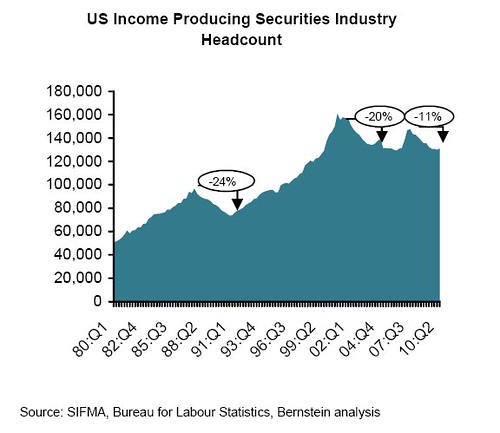
Source: Sanford Bernstein
"We are still about as fat as we were prior to the crisis," says Hoffman-Becking. "The cuts should have been double or triple what they were, but they were prevented by the exceptionally strong fixed income revenues of 2009. In 1987 and 2001, investment banking revenues were down for two or three years, giving time for cuts, but in this case they bounced back a lot more quickly."
That bounceback is dissipating. And the market is starting to look overcrowded. Hoffman-Becking points out that the ABS, MBS and CMBS product markets are still closed and that the carcasses of failed firms like Lehman have merely been recycled by their new owners who are using them as a platform for global expansion.
"Essentially, over time investment banking revenues are ratcheting downwards and the industry will adjust its size," he predicts. Rates and FX are expected to suffer particularly, on the grounds that they are already commoditised but have benefited disproportionately from recent exceptional conditions.
The good news is that Hoffman-Becking doesn't necessarily anticipate big cuts in the next few months. For the moment, widening spreads are creating revenue opportunities again. "It's hard to predict, but once we're through this, the direction will be downhill," he suggests, depressingly.