A GRADUATE GUIDE TO....Mergers and acquisitions

Mergers and acquisitions (M&A) was always one of the most competitive sectors of the financial industry to break into, but with fewer places for graduates this year, now it's even tougher.
As the name suggests, M&A teams in investment banks advise client companies on mergers (where two companies join forces as equals), and acquisitions (where one firm takes over all or part of another).
Big investment banks aren't interested in small-fry M&A deals. They only start to get involved at the mid-market level, with transactions worth at least $100m. At the upper end, the deals can be worth billions.
Junior bankers work long hours and can expect to be busy assembling the required financial information and legal documentation late into the night if necessary.
It's not for the faint-hearted, points out the head of graduate recruitment at one bulge-bracket bank.
"You do have to work very hard and it's accepted that the hours will be long. Throughout this, at analyst level, you have to be incredibly accurate as all the financial modelling you're doing is essentially underpinning presentations and pitches that will eventually be given to the client."
Key players
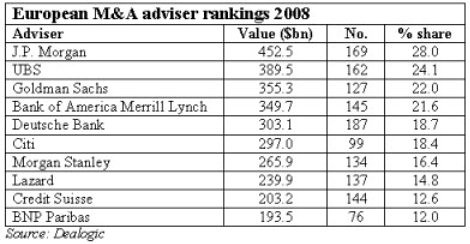
US bank J.P. Morgan gained the top spot in the European M&A advisory rankings in 2008, up from fifth place in 2007. UBS maintained its spot in second place, Deutsche Bank has risen from seventh to fifth and French bank Lazard has moved up two places to eighth.
Roles and career paths
There's a relatively straight route up the career ladder in M&A. You start out at analyst level, move up to associate, then vice president, director and managing director - although the job titles may vary depending upon the bank you work for. Within those roles you have the chance to focus on a particular sector, eg, consumer, financials, oil and gas, media and telecommunications.
The more senior you get in M&A banking, the more you'll get to deal face to face with clients. At the junior level you may attend a few client meetings with more senior bankers, but mainly you'll be focused on complex financial modelling and research to put together 'pitchbooks' for the bank. A pitchbook is the document the firm uses to outline its ideas on which companies a client should be buying or selling to.
Tiziana Galassini, executive director in the investment banking division of Morgan Stanley, says: "As an analyst, you need to be able to confidently work and run financial analysis and business planning. You will work closely with the associate level and be responsible for aspects like due diligence of a transaction and preparation of presentation material."
It's only later that you step away from the number crunching, says James Robertson, managing director in M&A at UBS. "At the mid-level you're very much involved in managing the process and making sure things run smoothly. If you're at the top, you're primarily ensuring the right tactics and advice are deployed about what should be paid, how it should be paid, and the terms of any purchase."
Skills and attributes
Given that you'll be working on complex financial models for valuing companies, and piecing together presentations to clients, numerical and analytical skills are essential. Second languages are valued for working with overseas clients, as are stamina and attention to detail.
Galassini says: "The complexity of M&A deals, particularly cross-border transactions, means that you encounter different cultures, regulations and fiscal and legal frameworks. An intellectual curiosity is needed to be able to draw all these aspects together."
Robertson says: "There's a lot of analysis to be done. The need to do things quickly on a limited timetable means everyone here works harder than in a lot of other areas of financial services."
This article is adapted from eFinancialCareers' 'Careers in Banking and Finance 2009/10', which is available free as a PDF download here